Corals (we know very little)

Common knowledge

My “common knowledge” about corals is: simply structured, plants rather than animals, reddish, forming coral reefs, existing near sea or ocean coasts.

What did I find out after I spent about eight hours to study them?

About corals

They are not simple at all. They are multicellular organisms with a complex anatomy. Their main component is the polyp. It has a central opening, which serves as both a mouth and an anus, and tentacles, which function as a “defense mechanism” and for food ingestion. Hard coral polyps secrete calcium carbonate in the form of skeletons, which “cement” individual structures into communities. Soft coral polyps do not secrete calcium carbonate and they are flexible. hard coral typesThey sway in the water with the waves, looking very much like plants. But corals are not plants; they are animals, which reproduce both sexually and asexually. Asexual reproduction occurs by budding or division and results in identical copies of the original polyps. (One whole colony can reproduce asexually and form two colonies, acting as a single organism.) Sexual reproduction is effected mainly by spawning and results in the formation of a large number of larvae called planulae, which metamorphose into polyps and form colonies. Corals have no color. The dead skeletal structures of the hard corals are white, but live corals are translucent animals which owe their different colors to the zooxanthellae algae they host. This symbiosis is beneficial for both “participants”: corals obtain most of their nutrients from algae’s products of photosynthesis and algae have a safe place to live and nitrogen, phosphorous, and carbon dioxide waste from the polyps “to eat”. When the rate of photosynthetic production is too high or when they have to live under stressful conditions (unfavorable changes in temperature, surrounding waters, nutritious substances), corals start to expel the zooxanthellae in their tissues and lose “their” color. This can lead to bleaching and death of whole colonies.
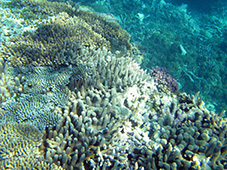
Coral reefs do not consist only of corals. They are complex ecosystems and homes for thousands of other marine species. This is the reason why they are often called the “rainforests of the oceans”. Interestingly, coral reefs are the largest living structures on the Earth, some of which are also visible from space. Because zooxanthellae algae need oxygen for their photosynthesis, most of the coral reefs exist in shallow and clear waters, but there are aggregations and communities of different sizes which develop in deep and cold waters. Most coral reefs are found in tropical and subtropical waters where the temperature and the movement of the waves are most favorable for their development. Those near the coasts have a protective function.

About me and the world around me

I know very little. My knowledge is not only superficial and incomplete, but partly wrong. I need a lot of time, discipline and organization to learn more. Even if I do my best and use all my free time to learn more about the world of nature, there remain other areas of human life like science, art, history, music, sport, etc., which I will never have the time or energy to study, let alone in detail. I need other people’s help to assist me in establishing the facts and I need reliable sources of information. I need to discriminate between reliable and unreliable sources of information.

The world around me is wonderfully beautiful and very complex. The more I learn about it, the better I understand how little I know about it. There are parts of the world that I and nobody else will ever see or experience. They are also beautiful and complex. There have been parts of the world which have disappeared or become extinct and which nobody has ever seen or experienced.

Gemplate asks:

  • If our life is so short and if we are so restricted in our abilities to comprehend the surrounding world, why is it so huge and immeasurable?
  • If there are parts and creatures which nobody will ever see, why are they there and why are they so diverse and complex?


Stonehenge (it matters how we arrange)

Stonehenge has been an enigma for centuries not only for people in Britain, where it is located, but for people all around the world. Nobody has said for certain what the purpose or function of this impressive stone monument has been throughout the various stages of its recorded history. Several of the most prominent hypotheses include: an astronomical observatory, a place of worship, a Neolithic hospital, a burial ground and a place for making offerings to gods. The last two are said to be evidenced by the remains of human bones found on the site. Different methods of dating have caused most archeologists to believe that it was built from around 3000 to around 2000 BC, but the precise course of the events is impossible to estimate because of the inadequacy of the measurement methods.

pic-small

Not being a professional archeologist or an engineer, I have no intention of writing a scientific report on the matter, but as a human being who is curious to know more about the world around us, I have all the rights to ask and answer questions that will help me to do so.

I also believe that it is our right and privilege to build on the progress of others in all areas of life which is why I will be using work and contributions made available to the general public by being posted on the internet by their authors. My main focus will be a 3D computer rendering of the overall site that has been released into the public domain by Wikimedia Commons.

My reason for doing so is that the author (or authors) of what is now known as Stonehenge (I believe that the final design was produced by the creative mind of one person whom I will discuss at greater length at the end of my exposition but was completed with the joint effort of a team of people) erected the structure in this specific place on purpose. If that was not so, why didn’t they build it somewhere else? Why did they decide to build it exactly there? For many reasons, I suppose, some of which will always remain unknown to us, as well as for some that they wanted us to know, because that was the purpose of building it on this particular site: “sending” a message to the future generations which was so important to the designer and his team that they devoted a large part of their lives, and probably wealth to making it happen. By building it there in that size and form, they wanted to say that their message was more important and of much greater value than all the other messages “sent” by the previous constructors.

The fact that they used such heavy stones, some of which were transported from southwest Wales (100-150 miles or 160-240 km away), instead of using rocks from the neighboring region (Stonehenge is one of the more than 350 similar monuments built in the surrounding areas), and the huge amount of time and effort they invested in completing it, should also point to the significance of the idea they wanted to convey.

If someone had such an important message to communicate, he wouldn’t risk much in terms of complexity/simplicity of the meaning. He would try to make it as simple as possible and not too simple at the same time, because either of the two would undermine both the meaning and the effect of the meaning.

The white stork (flying is faster in a flock)

The white stork is a member of the stork family. It is a large bird with long legs, a long slender neck and a long, straight, and pointed beak. Its length is 100-115 cm, its height when it is upright is 100-125 cm, its weight is 2.3-4.5 kg, and the spread of its wings is 155-215 cm. The wings are not only wide and long, but they are also very strong. Storks advance by flapping their wings with an up-and-down motion. This is a slow and regular movement, which enables them to soar up in the sky.

The white stork breeds in Europe, northwest Africa, southwest Asia and North Africa. It spends the winter in Africa, where it migrates following thermal air currents. These are invisible waves of warm air that rise from the earth due to its being heated by the sun and assist the uplifting of the birds.227x170 After reaching the highest point of the thermal current, the storks leave it, gliding gracefully over long distances of land. The position of the stork’s body and wings during gliding is such as to help the bird use as little of its energy as possible. Gradually, the birds lose height until they reach the next current. An individual stork is easily recognized from afar by its typical flying posture: a stretched neck and legs dangling close to one another.

It is easier for the storks to migrate in large flocks. When a bird finds a current, the rest follow it and start flying together. The greater the number of the birds in a flock, the higher the probability of finding a new thermal air current. This means that large flocks migrate faster than a bird flying alone. Under good conditions, they can travel up to 500 kilometers a day.

Storks feed on insects, reptiles, amphibians, small mammals and sometimes birds, fish, mollusks, crustaceans and scorpions. Some of these animals damage agricultural crops, which makes the stork a “pestful fork”. The carotenoids contained in the “food” of the storks account for the orange to red color of the beak and the brownish-red or orange color of the legs. The coloration, in combination with the beautiful form of the body and the graceful flight, make the stork one of the most admired birds in the world.

Usually storks build their nests in close proximity to people: on rooftops, chimneys, walls, and electrical towers, which is often considered as a sign of “good luck”, but can be dangerous and annoying. The nests are large and serve as shelter for other species of small birds. The storks repair them every year. There are nests which have been used for hundreds of years!

Storks are well-known for their altruistic behaviors such as grooming each other’s heads or preening each other’s wings.

Gemplate asks:

  • Birds fly by the power of their wings and because of the way they are structured. If there were no birds at all, would people have invented the airplane?
  • If there were no birds at all, would people have invented the birds?
  • If wing flapping is so effective for soaring up into the sky, why don’t planes use this mechanism in order to gain height?