Common knowledge
My “common knowledge” about corals is: simply structured, plants rather than animals, reddish, forming coral reefs, existing near sea or ocean coasts.
What did I find out after I spent about eight hours to study them?
About corals
They are not simple at all. They are multicellular organisms with a complex anatomy. Their main component is the polyp. It has a central opening, which serves as both a mouth and an anus, and tentacles, which function as a “defense mechanism” and for food ingestion. Hard coral polyps secrete calcium carbonate in the form of skeletons, which “cement” individual structures into communities. Soft coral polyps do not secrete calcium carbonate and they are flexible. 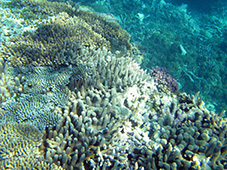 They sway in the water with the waves, looking very much like plants. But corals are not plants; they are animals, which reproduce both sexually and asexually. Asexual reproduction occurs by budding or division and results in identical copies of the original polyps. (One whole colony can reproduce asexually and form two colonies, acting as a single organism.) Sexual reproduction is effected mainly by spawning and results in the formation of a large number of larvae called planulae, which metamorphose into polyps and form colonies. Corals have no color. The dead skeletal structures of the hard corals are white, but live corals are translucent animals which owe their different colors to the zooxanthellae algae they host. This symbiosis is beneficial for both “participants”: corals obtain most of their nutrients from algae’s products of photosynthesis and algae have a safe place to live and nitrogen, phosphorous, and carbon dioxide waste from the polyps “to eat”. When the rate of photosynthetic production is too high or when they have to live under stressful conditions (unfavorable changes in temperature, surrounding waters, nutritious substances), corals start to expel the zooxanthellae in their tissues and lose “their” color. This can lead to bleaching and death of whole colonies.
Coral reefs do not consist only of corals. They are complex ecosystems and homes for thousands of other marine species. This is the reason why they are often called the “rainforests of the oceans”. Interestingly, coral reefs are the largest living structures on the Earth, some of which are also visible from space. Because zooxanthellae algae need oxygen for their photosynthesis, most of the coral reefs exist in shallow and clear waters, but there are aggregations and communities of different sizes which develop in deep and cold waters. Most coral reefs are found in tropical and subtropical waters where the temperature and the movement of the waves are most favorable for their development. Those near the coasts have a protective function.
About me and the world around me
I know very little. My knowledge is not only superficial and incomplete, but partly wrong. I need a lot of time, discipline and organization to learn more. Even if I do my best and use all my free time to learn more about the world of nature, there remain other areas of human life like science, art, history, music, sport, etc., which I will never have the time or energy to study, let alone in detail. I need other people’s help to assist me in establishing the facts and I need reliable sources of information. I need to discriminate between reliable and unreliable sources of information.
The world around me is wonderfully beautiful and very complex. The more I learn about it, the better I understand how little I know about it. There are parts of the world that I and nobody else will ever see or experience. They are also beautiful and complex. There have been parts of the world which have disappeared or become extinct and which nobody has ever seen or experienced.
Gemplate asks:
- If our life is so short and if we are so restricted in our abilities to comprehend the surrounding world, why is it so huge and immeasurable?
- If there are parts and creatures which nobody will ever see, why are they there and why are they so diverse and complex?