I tried to see some meaning in the number of the stones, but I couldn’t think of any (besides, some might have been taken, used or damaged). I suppose it was important, but not as important as their position and especially the presence or lack of connection between them. And for me, this is the key to the meaning of the message of the whole construction. When I looked at the construction more carefully, my first association was: these are human figures. The uprights are the bodies of the figures and the lintels are their hands. The paired stones symbolize the union between a man and a woman, from which children are born. These are the small stones in front of the trilithons. 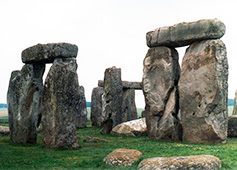 The giant trilithon in the center could represent the leading pair of the whole group. Obviously, the designer considered the paired couple as the most stable and powerful element of the structure, giving it such a central place and size. (The horseshoe is the element that gives stability to the horse and makes it able to walk and work more efficiently.) The structure is not a circle to express the idea of incompleteness and the possibility for new pairs to be formed. The circle of smaller stones represents the individual members of the community who are not connected by a “marriage” union. They are smaller in size, because they are not so important or not so “grown” as the paired members. The “ring” of connected stones represents those “grown-up” members of the community who are united in their unanimity of thought, purpose, conduct, and attitude and can be compared to people taking part in a round dance.
The whole arrangement speaks of order, organization, coordination, unity, oneness, involvement, illumination, clarity and freedom. The holes between the stones are symbolic of the possibilities for those who want to become part of this kind of organization to do so, or for members who no longer want to belong to it to leave it. The shadow is a symbol of the long-lasting effect of this kind of organization should it be accepted and implemented by the separate members of the society and by the society as a whole.
As for the character of the designer, I think he was probably a man of high social and economic standing, considerable influence and capabilities, as well as power, in order to be able to achieve such a huge engineering feat. He must have been someone who knew well the behavior of large communities both at their worst and at their best. He cared about people and valued them highly not only as individuals “weighing heavily” in their positions and responsibilities, but also as parts of a common structure functioning with one accord in the light of what is good and beneficial to all. He was undoubtedly very industrious, an excellent manager and a wonderful communicator, all of which is marvelously demonstrated by this mind-boggling “genigma”.
Gemplate asks:
- What would happen if any of the elements of this construction is taken out or if its form is changed?
- What will happen if the whole construction is moved several meters to the left or to the right?
- Why were some of the stones taken from Wales, and not from some other part of Britain?
- Could the construction have been designed as a place for burial?
- Is the way the monument was built an important part of the meaning of the message?
- Is the so called “Altar Stone” part of the original design or an addition by someone else? If so, why was it “added”?