The white stork is a member of the stork family. It is a large bird with long legs, a long slender neck and a long, straight, and pointed beak. Its length is 100-115 cm, its height when it is upright is 100-125 cm, its weight is 2.3-4.5 kg, and the spread of its wings is 155-215 cm. The wings are not only wide and long, but they are also very strong. Storks advance by flapping their wings with an up-and-down motion. This is a slow and regular movement, which enables them to soar up in the sky.
The white stork breeds in Europe, northwest Africa, southwest Asia and North Africa. It spends the winter in Africa, where it migrates following thermal air currents. These are invisible waves of warm air that rise from the earth due to its being heated by the sun and assist the uplifting of the birds.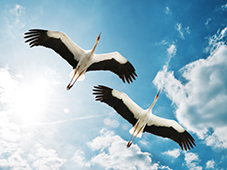 After reaching the highest point of the thermal current, the storks leave it, gliding gracefully over long distances of land. The position of the stork’s body and wings during gliding is such as to help the bird use as little of its energy as possible. Gradually, the birds lose height until they reach the next current. An individual stork is easily recognized from afar by its typical flying posture: a stretched neck and legs dangling close to one another.
It is easier for the storks to migrate in large flocks. When a bird finds a current, the rest follow it and start flying together. The greater the number of the birds in a flock, the higher the probability of finding a new thermal air current. This means that large flocks migrate faster than a bird flying alone. Under good conditions, they can travel up to 500 kilometers a day.
Storks feed on insects, reptiles, amphibians, small mammals and sometimes birds, fish, mollusks, crustaceans and scorpions. Some of these animals damage agricultural crops, which makes the stork a “pestful fork”. The carotenoids contained in the “food” of the storks account for the orange to red color of the beak and the brownish-red or orange color of the legs. The coloration, in combination with the beautiful form of the body and the graceful flight, make the stork one of the most admired birds in the world.
Usually storks build their nests in close proximity to people: on rooftops, chimneys, walls, and electrical towers, which is often considered as a sign of “good luck”, but can be dangerous and annoying. The nests are large and serve as shelter for other species of small birds. The storks repair them every year. There are nests which have been used for hundreds of years!
Storks are well-known for their altruistic behaviors such as grooming each other’s heads or preening each other’s wings.
Gemplate asks:
- Birds fly by the power of their wings and because of the way they are structured. If there were no birds at all, would people have invented the airplane?
- If there were no birds at all, would people have invented the birds?
- If wing flapping is so effective for soaring up into the sky, why don’t planes use this mechanism in order to gain height?