There is no doubt that life on the Earth would be impossible without the Sun. I am going to look for some facts about the Sun and its effects, but before I do that, I want to share some thoughts about how significant it is for us to know that.
I suppose I will find out facts that I haven’t known up to now. Probably, you will find out facts that you haven’t known up to now. There will be facts about the Sun that nobody will ever know, at least nobody from our generation, as there have been facts that people from older generations didn’t know about. But even without knowing them, we all live because of the Sun and the combination of its effects on the Earth.
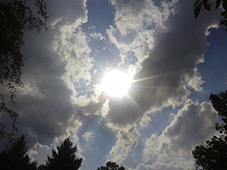 I must admit that I am not very certain about the truthfulness of all the facts that I will find out. If people once thought that the Sun revolved around the Earth and it took centuries of observation and investigation to establish the opposite, what guarantees the absolute truthfulness of all the facts that are said to be true now? I am particularly skeptical about facts like the Sun’s age or the Sun’s core density. It is claimed to be about 4.5, 4.6 or 5 billion years old (as if 1 or 5 billion years is not much of a difference) and its core density is said to be 150 or 160 grams per cubic centimeter (again a difference, which speaks of uncertainty).
I would very much like to be able to answer truly or find true answers to all the questions not only about the Sun, but about everything. However, this doesn’t seem to be possible. What seems possible though is to admit that our knowledge is partial and incomplete and sometimes even wrong. We need to develop and correct it and scientific progress helps us do that, but science does not have all the answers and certainly not all the full answers. Also, no matter whether we know all the answers or not, or whether our answers are right, wrong or partially right and partially wrong, the Sun is there in all its grandeur “rising up” every morning and “going down” every evening to provide faithfully the energy necessary for the existence of life on the Earth.
What is the Sun?
The Sun is a star, which is situated at the center of the Solar System (the Earth being the third planet after Mercury and Venus). It is almost a perfect sphere and consists only of gases (mainly hydrogen, a little helium and “traces” of oxygen, carbon, nitrogen and other elements). It rotates around its axis once in about 27 days, but unlike the Earth, which is solid, it spins with different speeds at its equator (faster) and at its poles (slower). This is called “differential rotation”.
The interior of the Sun cannot be seen directly so the internal structure is “deduced” by the methods of helioseismology (observations of the waves on its surface). Scientists think that the innermost part of the Sun, the core, is very dense (holding about half of its total mass but occupying a very small part of its volume) with the extreme temperature of about 15,700,000 degrees Celsius (“responsible” for breaking the atoms into protons, neutrons, nuclei, and free electrons). It acts as a furnace where energy is produced through fusion. The other two parts of the Sun’s interior are the radiative zone and the convective zone. The terms speak for themselves. The radiative zone is the layer in which energy is transferred by radiation. It occupies the largest part of the radius (some sources say 70%, others ─ 85% probably including the core). There is no generation of energy – just transfer by light (photons) from particle to particle. The convective zone (about 30% of the Sun’s radius) is the third, outermost layer of the solar interior, where energy is transported by convection (rising movements of hot gas next to falling movements of cool gas). Convection replaces radiation because of the fall in temperature (about 2,000,000°C at the base of the convective zone) which causes the heavier ions (carbon, nitrogen, oxygen, calcium, and iron) to hold onto some of their electrons making the material more opaque and harder for radiation to get through. Convection facilitates energy transfer and makes it faster.
The visible surface of the Sun is the photosphere (light sphere) where the photons leave the star and escape to space. Being a ball of gas, the Sun does not have a well-defined surface. The area where the density becomes opaque is where the photosphere starts. It shapes the disk which we see in the sky and call the “Sun”. Once again energy is transported by radiation. Although the temperature is quite cool (about 5,500°C), the gas is thin enough for the atoms to absorb and release energy. The photosphere has a number of features that can be observed with a telescope: sunspots (regions of strong magnetic fields making the Sun look darker), faculae (again magnetic fields but concentrated in smaller bundles making the Sun look brighter) and granules (the tops of convection cells covering the entire Sun except the areas of the sunspots).
The parts above the photosphere comprise the solar atmosphere: the temperature minimum, the chromosphere, the transition region, the corona and the heliosphere. Up to the photosphere, the temperature and density of the gas decrease, but above the photosphere the temperature starts to increase (the reason is not well known), whereas the density continues to decrease. The coolest region is the temperature minimum region. The chromosphere, the transition region and the corona are much hotter than the surface of the Sun. The heliosphere (discovered in the 1950’s) is the region of action of the solar wind containing the solar system and the entire solar magnetic field. Although its precise size is not known, it is said to extend far beyond Pluto.
What does it do?
The Sun acts as a gigantic nuclear reactor and as such, it radiates energy. The energy is emitted as light (ultraviolet light, X-rays, visible light, infrared, microwaves, radio waves). It also emits energized particles (neutrinos, protons) that make up the solar wind. The solar wind is not uniform; it changes its speed and carries magnetic clouds. When it passes by the Earth, it affects its magnetic field and can cause storms in its magnetosphere. The Earth’s ionosphere is also affected by the behavior of the solar wind.
The Sun’s energy warms the Earth and is the main factor determining the Earth’s climate and weather. The total solar energy absorbed by the Earth’s atmosphere, oceans and land masses is approximately 3,850,000 EJ (exajoules) per year.
No biological and physical processes will be possible without the Sun’s energy, which means that no life will be possible either.
Gemplate asks:
- The pressure at the core is said to be about 250 billion times the pressure of the atmosphere at the Earth’s surface. However, the Sun’s mass does not collapse inward due to the outward pressure generated by the heat of the core, nor does it explode outward because the mass of the gases above the core contain its explosiveness. How has this incredible “constraint” come into being?
- Solar flares are violent explosions in the Sun’s atmosphere with an energy release equivalent to millions of hydrogen bombs exploding at the same time and producing radiation across the entire electromagnetic spectrum. They can be followed by coronal mass ejections and strongly influence the space weather near the Earth. On reaching the Earth (a day or two after the event), the flares can affect its magnetosphere or ionosphere and present different kinds of hazards. What would happen if the Sun gave off tens or hundreds of flares at the same time? What constrains it so that it doesn’t do that?
- Solar energy is utilized by a number of new technologies such as solar heating, solar photovoltaics, solar thermal electricity, solar architecture, artificial photosynthesis, etc. One source says that the amount of solar energy reaching the planet in one year is about twice as much as can ever be obtained from all non-renewable resources. What would happen if this amount was used fully?