“We grey whales hold the absolute long distance record for all mammals – and we do it by swimming. We do the same thing the migrating birds do, an annual 10,000 km journey from the northern Arctic Ocean, through the Bering Straits, to the Aleutians, down the Pacific Coast of America, till we reach the Mexican peninsula of Baja California. Precisely at Christmas time we reach the Californian city of San Diego. We don’t fly in “V” formation like the Golden Plover, but as a group of 40 or so animals, we form an impressive Grey Whale Armada, that navigates unerringly 185 kilometres per day to our goal.
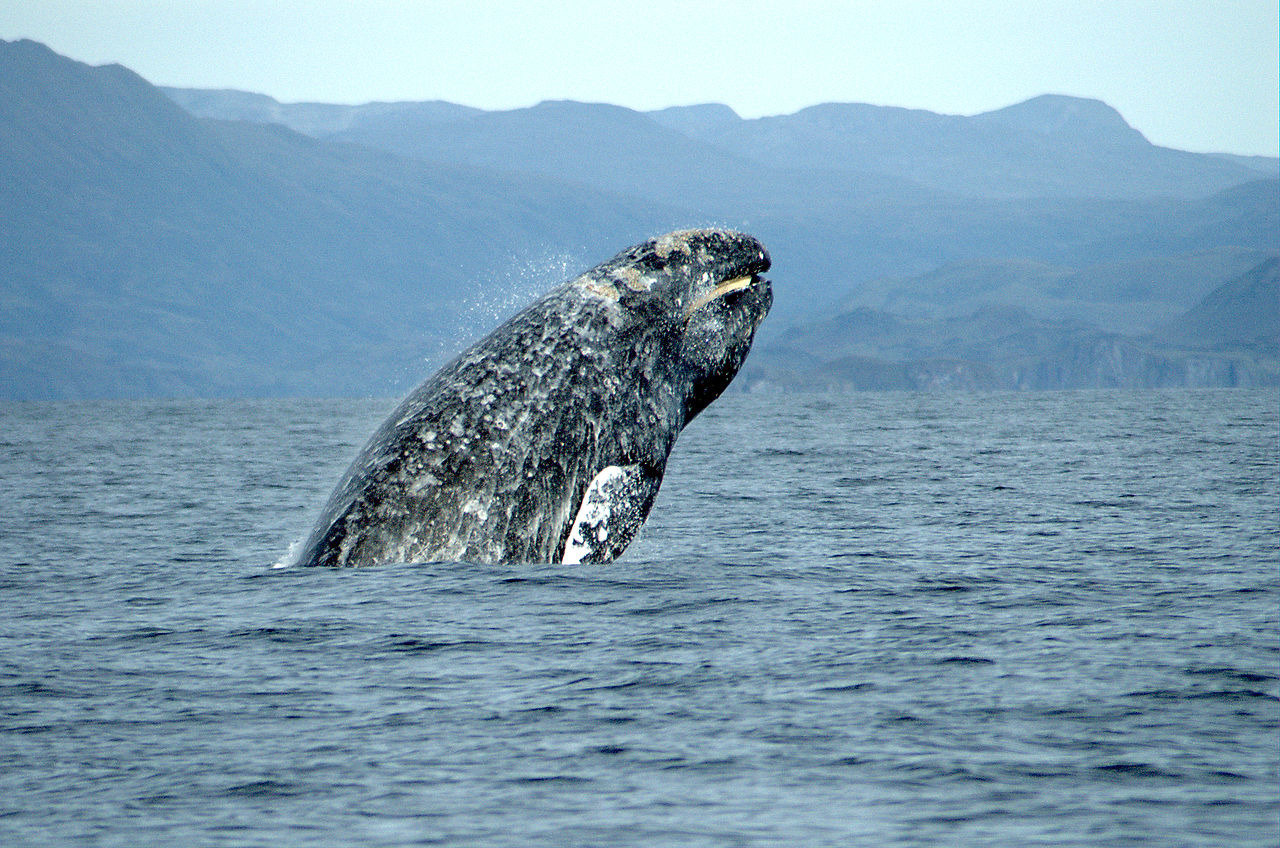 Why is it that we take such a long journey, travelling 20,000 km counting the return trip? Just think, that’s half the length of the equator, or as far as you would drive your car in a year, if you were driving a lot! You think we travel down south because there’s more food there at that time of year? No, not at all. Actually, the opposite is the case. We can hardly find anything edible there. As a matter of fact, we end up eating next to nothing for a period of six months. The only reason we go through all this is for the sake of our children. Our babies are born at the end of January, and we have to be in the quiet lagoons at San Ignacio on the coast of Baja California. Now you understand why almost all of us grey whales have the same birthday. Even though our babies are 4.5 metres long at birth, and weigh 1.5 tons, they have almost no fat layer at all, nothing to protect them against the cold of the northern Arctic waters. Our young drink 200 litres of milk and gain 20 kg per day. Our babies drink this extremely nutritious milk for eight long months. For two months, our children are trained in the Baja nursery to be capable long-distance swimmers, so that they are fit enough to make the long return trip to the far north. This all takes place while the mother is fasting. Even the fathers come along, and fast, during this long trip. We need them along, for one thing, because they protect us from the attacks of Killer whales. The other reason is that, it’s there in the Gulf of California that we have our short mating season. When we return to the Arctic, you can understand that we have nothing on our minds but food. When we get back, we feast on krill by the ton, and once again build up a thick layer of fat. This “blubber” layer can be more than a foot thick. We need this blubber not just for insulation from the cold, but also as an energy reserve, during our next long foodless trip south.
Did We Whales Evolve, or Were We Especially Created?
Many of your scientists believe that we are former land animals that returned to the water. But if you have paid attention, you have seen that we are formed in such extraordinary ways, and have such special capabilities, that no land animal is remotely like us.
Just think about
- Our birth in the breech position
- Our nursing procedure under water
- Our special organs for deep diving
- Our ability to compose music
- Our ear construction
- Our special nose
- Our filter apparatus
- Our long foodless migration.
Evolution for us is impossible. A half-baked diving apparatus wouldn’t do us any good at all. Unless I had a complete filtration system, I would starve to death. If I were born head first, rather than tail first, there simply wouldn’t be any whales…”
The excerpt was taken from Werner Gitt and Karl- Heinz Vanheiden’s book ‘If Animals Could Talk’.
Gemplate asks:
- Why do these animals have to travel such a long distance in order to breed their young? Isn’t it a waste of power and resources to do that? Wouldn’t it be much easier and less energy or time consuming for them to breed in the north? What lessons can we learn from them about life and its diversity?
- Can you make all the grey whales stop migrating to the south and stay in the north for all of their lives, while changing their breeding habits and the way their young are born?
- Why do some creatures have to eat every day in order to live while others (camels, sharks, frogs, bears, etc.) can survive without food and even without water for long periods of time and be still fit for life? What do these facts show us and who made it possible to be so?
- If evolution was impossible for some, couldn’t it be impossible for others as well, and if, yes, how did life originate?